



A Cornerstone of Modern Naval Warfare: Strategic Analysis of Arleigh Burke-Class Destroyers
1. Introduction: From Controlled Seas to Contested Waters
The modern naval warfare environment is undergoing a profound transformation driven by the proliferation of anti-access/area denial (A2/AD) strategies, distributed lethality doctrines, and the asymmetric impact of autonomous systems. The seas are no longer domains of absolute control; instead, they are increasingly defined as “contested waters,” extending from the subsurface domain to the space layer, where persistent competition prevails.
Within this multi-layered and high-intensity operational environment, Arleigh Burke-class guided missile destroyers (DDGs) have remained at the core of modern navies’ Sea Control and Power Projection capabilities for more than three decades.
The process that began with the commissioning of DDG-51 Arleigh Burke in 1991 transformed the platform from a surface combatant into the true “muscle” of U.S. naval power and allied operational architectures. Today, the class is widely regarded as one of the most tangible embodiments of deterrence, defining the maneuver space of naval forces on the geopolitical chessboard.
2. Program Origins: Cold War Legacy and Doctrinal Transformation
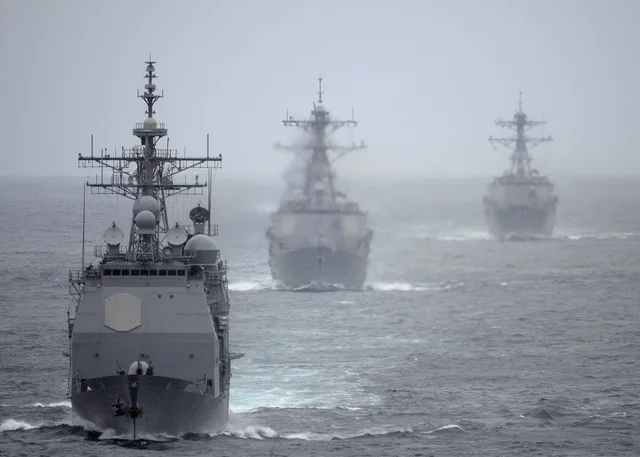
The origins of the Arleigh Burke class trace back to the Cold War environment of the 1980s, when the United States sought to preserve qualitative superiority against Soviet naval power. The U.S. Navy identified the need for a new-generation destroyer platform to replace the Charles F. Adams and Farragut classes, while bridging the gap between the anti-submarine warfare focus of the Spruance class and the high-capacity air defense architecture of Ticonderoga-class cruisers.
Developed in response to this requirement, the Arleigh Burke class marked a milestone in the transition from single-mission platforms to multi-role, network-centric warfare nodes by fully integrating the Aegis Combat System into a destroyer hull. The program represented not merely a new ship, but a tangible shift in U.S. naval doctrine from platform-centric thinking toward system- and network-centric warfare.
3. Operational Architecture: A Multi-Mission Force Multiplier
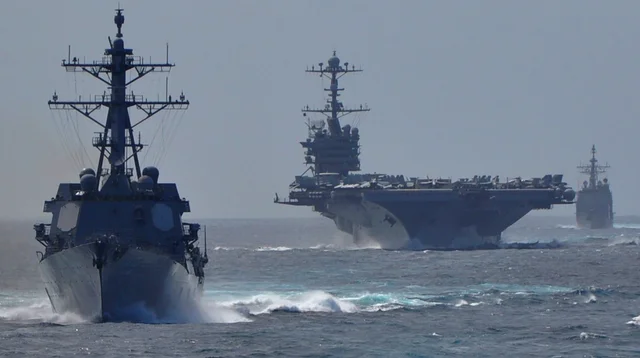
The Arleigh Burke class features a multi-mission architecture designed to maximize operational flexibility. These ships are capable enough to conduct independent operations, yet sufficiently interoperable to integrate seamlessly into Carrier Strike Groups (CSGs) and Amphibious Ready Groups (ARGs).
Primary Operational Roles
- Integrated Air and Missile Defense (IAMD): Layered defense against ballistic missile threats and advanced air-breathing targets
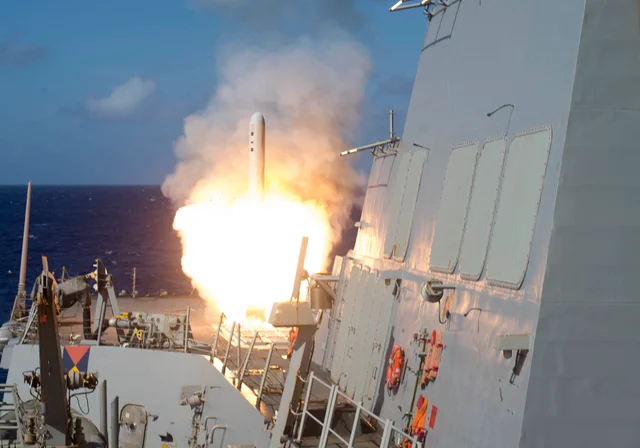
- Strike Warfare: Precision engagement of strategic land targets using Tomahawk cruise missiles via the Mk 41 VLS
- Anti-Submarine and Surface Warfare (ASW / ASuW): Sea control enabled by advanced sonar suites, helicopter integration, and surface sensors
- Intelligence, Surveillance, and Reconnaissance (ISR): Regional situational awareness and network-centric data sharing
Traditionally focused on land attack and air defense missions, these platforms are now being re-equipped under the modern Distributed Lethality doctrine with systems such as the Naval Strike Missile (NSM), enabling a return to the “hunter” role against high-tonnage adversary surface combatants in open-ocean environments.
4. Design Evolution: From Flight I to Flight III
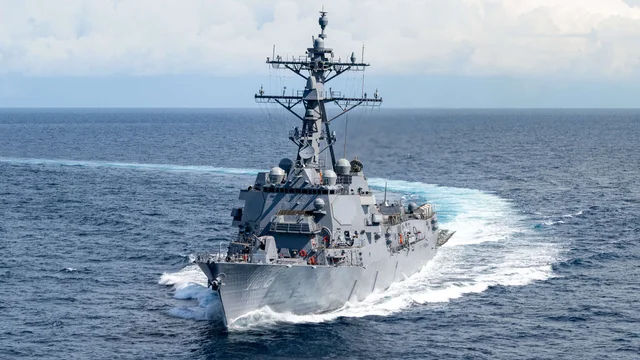
The most distinctive feature of the Arleigh Burke class is its continuous evolution through an iterative development model. Each “Flight” variant represents a doctrinal response to the U.S. Navy’s evolving threat perception.
Flight I / II (DDG-51 – DDG-78)
- First full integration of the Aegis combat system into a destroyer hull
- Design focused on air defense and escort missions in the post–Cold War period
- Absence of a helicopter hangar, offset by high seakeeping performance
Flight IIA (DDG-79 – DDG-124)
- Expanded ASW capability with dual MH-60R Seahawk helicopter hangars
- Independent mission execution in littoral (shallow-water) environments
- Enhanced electronic warfare and command-and-control infrastructure
Flight III (DDG-125 and beyond)
- Integration of the AN/SPY-6(V)1 radar and Aegis Baseline 10
- 4160 VAC electrical architecture with increased cooling capacity
- A sensor revolution focused on the concept of “buying back battlespace”
5. Technical Leap from Flight I to Flight III
Evolution of Displacement Capacity
While Flight I / II variants operated in the 8,500–9,000 ton range, Flight IIA reached approximately 9,500 tons, with Flight III exceeding 9,600 tons.
Primary Radar Systems
Early variants employed the AN/SPY-1D radar, followed by the improved AN/SPY-1D(V) in Flight IIA. With Flight III, the class transitioned to the AN/SPY-6(V)1 (AMDR) radar architecture.
Electrical Infrastructure
Flight I and IIA variants utilized a 450 VAC electrical system, whereas Flight III introduced a 4160 VAC architecture to support high-energy-demand sensors and systems. This electrical upgrade underpins not only radar performance but also future directed-energy weapons such as HELIOS, enabling revolutionary defenses against low-cost UAV swarms without traditional magazine constraints.
Helicopter Integration
While Flight I and II variants lacked helicopter hangars, Flight IIA and Flight III ships can embark two MH-60 Seahawk helicopters.
Aegis Combat System Evolution
Flight I and II ships fielded Aegis Baseline 5/7, Flight IIA employed Baseline 7/9, and Flight III incorporates Aegis Baseline 10.
Flight III not only modernized the Arleigh Burke class, but also aligned its sensor, energy, and data-processing capacity with the threat environment of the coming decades.
Despite these technological advances, personnel density remains the class’s greatest logistical burden. A crew requirement of approximately 350 personnel increases life-cycle costs, while the transition to highly automated systems, as seen in the Constellation-class frigates, represents a physical design limit for the Arleigh Burke hull.
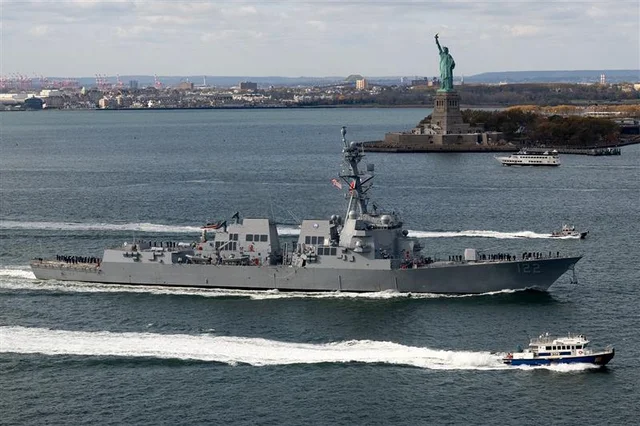
6. Iconic Capabilities: Aegis, Sensor Architecture, and Survivability
The Aegis Combat System is not only the “brain” of the Arleigh Burke class, but also its shield. With the integration of Aegis Baseline 10, the platform has evolved into a force-level command-and-control node.
AN/SPY-6(V)1 Radar Capabilities
- Digital beamforming
- Modular Radar Modular Assembly (RMA) architecture
- +15 dB sensitivity increase compared to previous generations
This architecture enables ballistic missile defense, hypersonic threat detection, and simultaneous engagement against dense air attack scenarios.
Survivability and Damage Control Approach
- All-steel superstructure
- Kevlar armor in critical areas
- Advanced damage control and NBC defense systems
7. Industrial Architecture and Program Milestones
The Arleigh Burke program represents one of the largest industrial collaborations in U.S. defense history.
Key Industrial Stakeholders
- Shipbuilding: Bath Iron Works & Huntington Ingalls Industries
- Aegis Combat System: Lockheed Martin
- Radar Systems: Raytheon
- Electronic Warfare (SEWIP): Northrop Grumman
- Propulsion Systems: General Electric (LM2500)
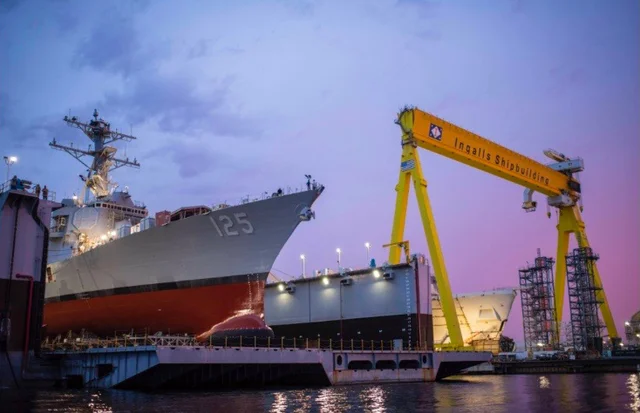
DDG-125 Jack H. Lucas, as the lead ship of Flight III, represents one of the program’s most critical milestones and the first operational embodiment of the next-generation destroyer concept.
8. Production Scale and Fleet Impact
The Arleigh Burke class is the most widely produced guided missile destroyer class in modern naval history. More than 70 ships have entered service to date, with the production line remaining active. The final number is expected to exceed 90 units.
Strategic Advantages of This Scale
- Logistical continuity
- Standardized modernization
- Fleet-wide interoperability
9. Fleet-Level Impact and Global Deterrence
The defining advantage of the Arleigh Burke class lies not in technical specifications alone, but in accumulated operational depth. While China’s PLAN Type 052D and Type 055 classes may offer numerical advantages, decades of integration experience and a global logistics network elevate the Arleigh Burke class into a system-above-the-system force for the U.S. Navy.
10. Conclusion: A Bridge to the Future
With a service life extending into the 2050s, the Arleigh Burke class is not merely a series of ships, but a living architecture of modern naval warfare thought. The U.S. Navy’s future vision positions Arleigh Burke-class destroyers as “primary command nodes,” orchestrating unmanned surface (USV) and subsurface (UUV) vehicles, fusing sensor data, and executing strike decisions. In this construct, the Arleigh Burke is no longer a platform that fights alone, but the core of a networked warfighting system.
Yet the critical question remains: In an era defined by hypersonic weapons, autonomous swarms, and AI-enabled warfare, will the iterative modernization model embodied by the Arleigh Burke class remain sufficient to preserve maritime superiority in the long term?
The answer lies not solely in the ship itself, but in the evolution of the doctrine, industry, and strategic ecosystem that surrounds it.