



Belharra (FDI) Class: The Digital-First Frigate Concept of Modern Naval Warfare
1. Introduction | Why Is a New-Generation Frigate Concept Needed?
Modern naval warfare has evolved beyond a competition defined solely by platform tonnage and weapons payload, into an environment where contested waters have become the norm. The proliferation of A2/AD capabilities, coastal-to-deep-water sensor networks, low-cost UAV/USV threats, and accelerated missile engagement cycles have made maritime deterrence as dependent on data generation, sharing, and decision speed as on platform firepower.
In this environment, the traditional “multi-role frigate” concept is increasingly strained by the simultaneous demands of saturation-attack resilience, submarine threat management, and functioning as a reliable node within network-centric task groups. The Belharra class should therefore be assessed as a digital-first frigate architecture shaped to respond to this evolving requirement set.
2. The Emergence of the Belharra (FDI) Class
Belharra is the export designation of Naval Group’s FDI (Frégate de Défense et d’Intervention) family, conceived as a frigate concept designed to generate high combat density on a compact hull of approximately 4,500 tons. This approach is based on the assumption that larger, more costly platforms are no longer sustainable for every navy, while advanced capabilities can be preserved through a more compact yet digitally driven backbone.
The export-oriented nature of the class encourages a modular architectural framework that is not bound to a single national requirement, allowing configurations to be adapted to different threat perceptions and doctrinal priorities.
This compact architecture forms the basis for two core variants, illustrating how a balance can be struck between the French Navy’s requirement for operational agility (FDI) and the Hellenic Navy’s emphasis on enhanced firepower (FDI HN).
3. Network-Centric Warfare Capability | Digital Backbone, SETIS, and Cyber Resilience
The defining characteristic that makes Belharra a next-generation platform lies not in the sum of its sensors and weapons, but in the architectural approach that transforms these elements into an active node of network-centric operations. The SETIS combat management system (CMS) is designed to fuse sensor data into a coherent tactical picture, support target prioritization, and enable data sharing with joint forces under suitable conditions.
Within this framework, Belharra is positioned to generate a high-quality tactical picture and to accelerate the decision cycle within a task group.
From a cyber resilience perspective, cybersecurity is treated not as an add-on layer but as an intrinsic design element. Digitalization, if not supported by appropriate workflows and architecture, can increase cognitive load; therefore, Belharra’s performance must be evaluated not only at the sensor or weapon level, but also through the operational usability of its data processing and decision-support processes.
4. Design Aesthetics and Hydrodynamics | Radical Appearance, Operational Rationale
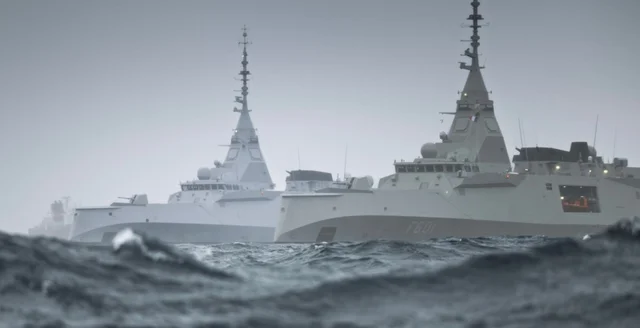
The external appearance of the Belharra class deliberately departs from conventional frigate silhouettes. The inverted bow design, while visually reminiscent of 19th-century vessels, is a functional choice rooted in modern hydrodynamic principles.
This design aims to cut through waves rather than climb them in heavy seas, reducing vertical accelerations acting on the hull. As a result, sensor platform stability is enhanced, transit continuity is maintained, and operational tempo is less frequently disrupted under high sea states.
The same geometric approach also contributes to controlling radar reflective surfaces. In this respect, the inverted bow serves as a complementary design element that unifies Belharra’s seakeeping performance and low-observable (stealth) approach through a single structural form.
5. Sensor Suite and Situational Awareness | AESA Radar, EW/ESM, and ASW Integration
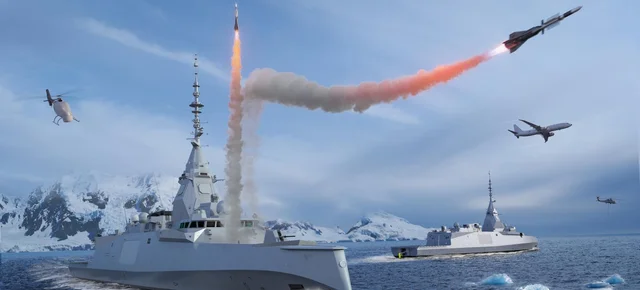
Belharra’s distinguishing feature lies not in the individual presence of its sensors, but in the reliability of the tactical picture they collectively generate. The AESA main radar architecture is intended to meet modern demands such as dense track generation and dynamic target tracking.
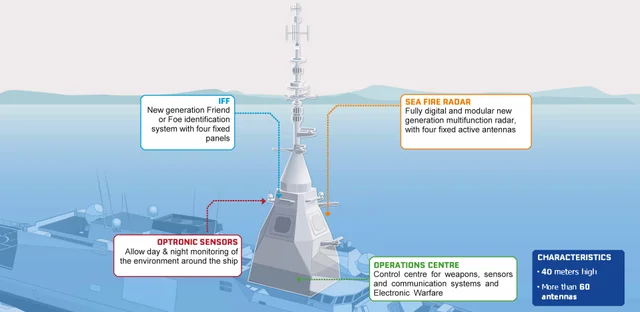
At the core of this architecture is the Panoramic Sensors and Intelligence Module (PSIM), which consolidates sensors into a single integrated mast rather than dispersing them across the ship. This approach can be understood as a “plug-and-play sensor module” where all primary sensing elements are brought together within one structure.
Electronic warfare (EW) and ESM components form an integral part of this integrated sensing architecture, preserving the coherence of the sensor picture. On the ASW side, hull-mounted and towed sonar concepts gain operational relevance only to the extent that sensor fusion and sustainability can be maintained under real mission tempo.
6. Weapon Systems and Mission Profiles | AAW, ASW, ASuW, and Self-Defense
The most effective way to assess Belharra’s weapons architecture is through mission profiles rather than inventory listings.
While the theoretical layout of weapon systems reflects the flexibility of the Belharra architecture, the platform’s actual strike potential exhibits distinct characteristics across French and Hellenic variants depending on the selected VLS cell count and missile configuration.
This theoretical engagement capacity translates into tangible force multipliers in French or Greek configurations, shaped by missile type and vertical launch system capacity.
7. Platform Performance and Seakeeping | Propulsion, Endurance, and Air Component
With its compact hull, Belharra represents a frigate concept seeking balance between blue-water operations and regional/littoral mission environments. Platform performance derives meaning not only from speed and range, but from the ability to preserve sensor continuity and operational tempo in harsh sea conditions.
Air component integration significantly amplifies the platform’s effectiveness in OTH targeting, ISR, and ASW missions, while the sustainable operation of these assets under high sea states makes seakeeping performance a critical determinant of overall combat effectiveness.
8. Modularity, Variant Logic, and Export Potential
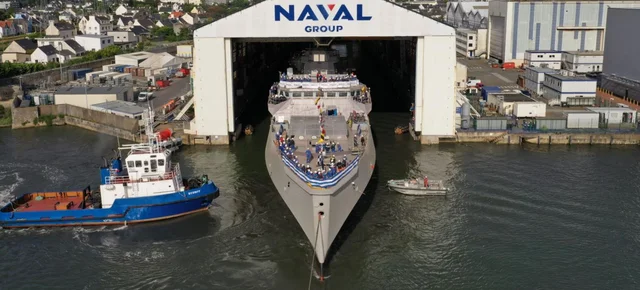
The export value proposition of Belharra is centered on its capacity to generate doctrine-specific configurations from a common hull. This flexibility transforms the platform from a single product into a scalable class adaptable to diverse user requirements.
However, as differentiation between variants increases, so do the risks associated with maintenance, training, and logistical complexity. Modularity must therefore be evaluated alongside long-term sustainability considerations.
Why Belharra?
- Half the crew, full capability
- High mission density on a compact hull
- Sensor-first, network-centric architecture
- Doctrine-driven variant flexibility
9. Conclusion | Belharra’s Strategic Summary
The Belharra (FDI) class is positioned as a digital-first, export-oriented frigate architecture responding to the data-dependent nature of modern naval warfare.
The operational manifestation of this digital and physical architecture can be more clearly understood through the specific variants designed as an “agile guardian” for the French Navy and a “power center in the Eastern Mediterranean” for the Hellenic Navy.
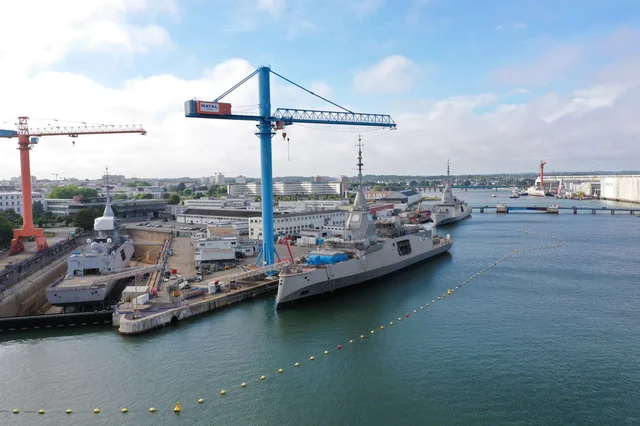
Ultimately, Belharra represents an attempt to translate a technology-driven “high-end” approach onto a compact hull; its success will depend on the extent to which its digital architecture can be aligned with the physical realities of naval warfare.





