



KIMON (FDI HN) Class Frigates: A High-Intensity Area Air Defense Platform for the Hellenic Navy
1. Introduction | Why KIMON?
Over the past decade, the Eastern Mediterranean and the Aegean Sea have become not only arenas of geopolitical competition but also one of the primary theaters for high-intensity naval-air operations. The regional operating environment is undergoing a radical transformation driven by missile saturation attacks, increasingly quiet and longer-range submarine technologies, and the proliferation of unmanned air and maritime platforms (UAV/USV). In this new ecosystem, generating naval power is shaped less by the number of platforms and more by the speed and continuity of the sensing–decision–engagement cycle.
Under these conditions, possessing conventional multi-role platforms alone is no longer sufficient; digitally-first platforms capable of delivering high sensor fusion, strong cyber resilience, and a layered defense architecture are no longer a preference but a necessity. In particular, the ability to generate area air defense at the task-group level stands out as one of the decisive elements of modern naval operations.
The KIMON class (FDI HN – Frégate de Défense et d’Intervention Hellenic Navy) has emerged in this context as the most aggressive, firepower-prioritized derivative of Naval Group’s Belharra architecture in operational terms. Unlike the FDI concept developed for the French Navy, which prioritizes agility, patrol persistence, and mission versatility, the Greek variant represents maximum deterrence capacity packed into a relatively compact hull.
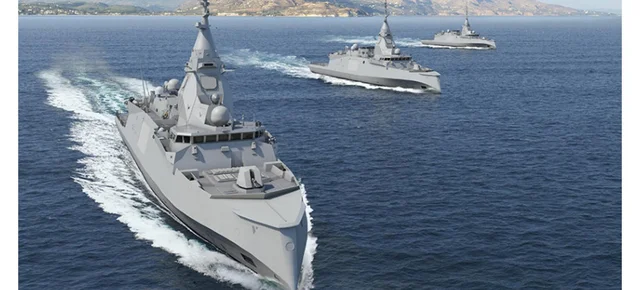
Thanks to their digitally-first architectures, these ships aim to be positioned not merely as individual platforms, but as high-value area air defense nodes within a task group. In this respect, the KIMON class should be assessed as a strategic family of platforms designed to deliver a qualitative transformation to the Hellenic Navy’s force structure rather than a purely quantitative increase.
2. Program Origins | Doctrinal Gap and Strategic Choice
For many years, the Hellenic Navy’s surface combatant force has relied on the Elli (Kortenaer) class frigates and the MEKO 200HN class platforms. However, the Elli class having effectively reached the end of its technological life, and the MEKO 200HN class requiring comprehensive modernization, has created a significant capability gap within the fleet.
From Athens’ perspective, the most critical doctrinal deficiency has been the inability to establish a layered area air defense architecture, one of the core requirements of modern naval operations. Existing platforms largely provide self-defense and limited task-group protection, and remain insufficient to generate a persistent and wide-area defensive umbrella against high-intensity air and missile threats.
Within this framework, four main factors proved decisive in selecting the FDI architecture:
- Area Air Defense Capacity: The need to create a wide-area protective umbrella using Aster 30 missiles.
- Sensor Technology: The superior detection capability of the Sea Fire AESA radar against low-observable and high-speed threats.
- Rapid Delivery and Digital Processes: A predictable and accelerated delivery schedule enabled by digital design and integration.
- Industrial and Strategic Dimension: A long-term strategic partnership established with the French defense industry.
As a result, the KIMON class has been positioned not as a temporary response to an aging inventory, but as the cornerstone of a new force structure centered on area air defense.
3. Platform Architecture | High Density in a Compact Hull
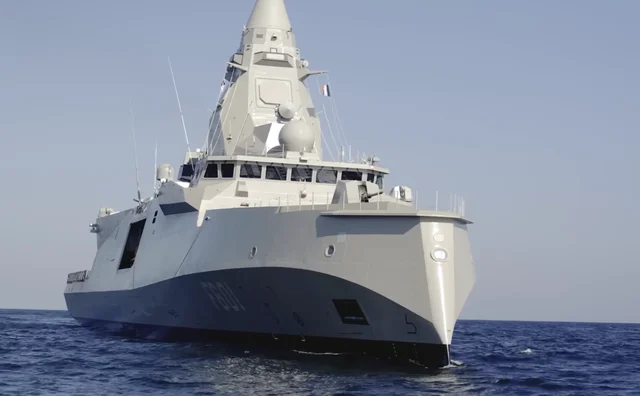
The KIMON class offers a comparatively compact form by modern frigate standards, with an approximate displacement of 4,400 tons and a length of 121.6 meters. However, this compactness does not reflect a capability trade-off; rather, it represents a deliberate engineering choice aimed at concentrating sensors, weapons, and mission systems within a constrained hull volume.
The CODAD propulsion system, producing roughly 32 MW, was selected to balance mechanical endurance and fuel efficiency across long-duration patrols, task-group escort missions, and sustained high-tempo operations.
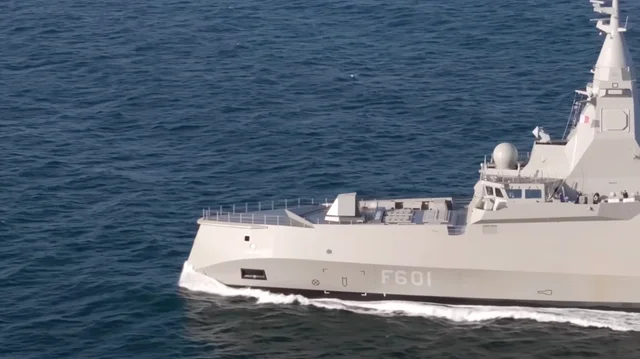
The inverted bow design aims to reduce slamming in higher sea states and improve hull stability. This approach is critical to ensuring that sensors integrated under the PSIM (Panoramic Sensors and Intelligence Mast) can operate stably and continuously even in challenging sea conditions.
4. Current Status and Delivery Timeline | Standard-1 and Phased Capability
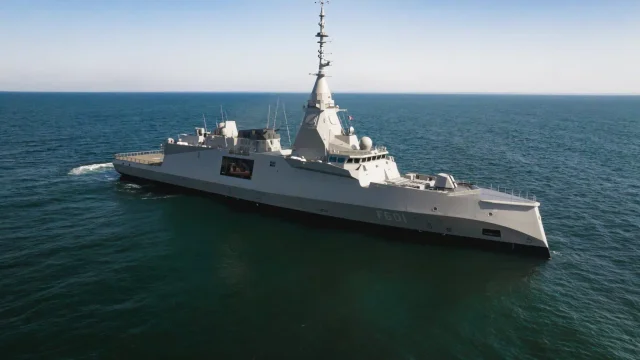
The first units of the KIMON class frigates are being delivered in a limited configuration referred to as “Standard-1” in order to rapidly close the operational capability gap. This approach accelerates the physical entry of platforms into the fleet while envisaging the acquisition of full warfighting capability through phased modernization.
In this context, the first two ships, HS Kimon and HS Nearchos, will enter service without the complete set of end-state capabilities. The main elements that will be missing at delivery or activated later are as follows:
- Vertical Launch System (VLS): Although the end-state goal is 32 cells, the first two ships will initially be delivered with 16 cells; modernization from 2027 onward will increase this number to 32.
- RAM Point-Defense System: The 21-cell Mk 31 RAM Block 2B system will be integrated under the Standard-2 upgrade.
- Cruise Missiles (MdCN / Scalp Naval): The first three ships will initially lack this capability; only the fourth ship, Themistokles, will be built with it.
- Multi-Purpose Launching System (MPLS): Integration of this system, developed against drones and asymmetric threats, is planned for the post-2027 period.
- System Activation: HS Kimon was delivered in a “hybrid” configuration, with some systems physically installed but not yet fully activated from a software and doctrine standpoint.
5. Key Differences from the French FDI | What Makes KIMON Unique
The KIMON class is not a one-to-one copy of the standard FDI configuration developed for the French Navy. Although the same hull and digital backbone are retained, mission priorities and payload distribution have been fundamentally rebalanced.
5.1 Area Air Defense Priority
While French FDIs were initially planned around a 16-cell VLS architecture, the KIMON class is designed to reach 32 Sylver VLS cells. This structure enables a mixed load of Aster 15 and Aster 30 missiles, providing both local and area air defense capacity. The 21-cell RAM Block 2B system positioned over the hangar forms a critical CIWS layer unique to the Greek variant.
5.2 Sensor Approach
The Thales Sea Fire AESA radar provides continuous 360-degree coverage through four fixed arrays. Under saturation attack conditions, it supports a high target refresh rate and tracking quality, maximizing the engagement effectiveness of Aster missiles.
5.3 Defensive Philosophy
Where French platforms favor the CANTO torpedo countermeasure system, the KIMON class employs the Sylena Mk1 decoy system. This choice reflects an approach aligned with the Hellenic Navy’s existing logistics infrastructure and regional threat assessment.
6. Weapons and Sensor Integration | Weapons–Doctrine Alignment
The KIMON class is managed by Naval Group’s SETIS Combat Management System, based on fully virtualized and redundant data centers. This digital backbone is a key element that makes the platform “resilient by design” against cyber threats.
- Air Defense: Sea Fire AESA + Aster 15/30 + RAM Block 2B combination.
- Anti-Submarine Warfare (ASW): Kingklip Mk2 and CAPTAS-4 Compact. Carrying CAPTAS-4 in a 4,400-ton hull makes the class one of the most powerful ASW platforms in its segment.
- Surface Warfare: 8 × Exocet MM40 Block 3C and the Oto Melara 76mm Super Rapid main gun.
- Asymmetric Threat Management: The PCLCMA center is optimized against swarm attacks through panoramic electro-optical sensors and automated detection algorithms.
7. Geopolitical Impact and Industrial Dimension
The KIMON class aims to increase Greece’s capacity to support its EEZ claims and energy corridors in the Eastern Mediterranean. The European Union SAFE (Security Action for Europe) loans considered for financing the program have also sparked debates over whether these acquisitions serve collective defense against the Russian threat or regional competition objectives.
The 65% European production content requirement under SAFE directly influences the program’s industrial architecture. At present, Greek shipyards take part in limited fabrication and lower-technology activities, while radar, sensors, and combat management systems are fully imported.
8. Operational Risks
- Logistics and maintenance complexity
- High training and manpower requirements
- Sustainability risk due to limited ship numbers
9. Conclusion | A Qualitative Force Multiplier
The KIMON class represents a qualitative leap, carrying the Hellenic Navy from an analog era into a network-centric, digitally-first warfighting architecture. While a phased capability acquisition approach may create certain operational limitations in the short term, it forms the foundation of an area air defense-focused force structure in the medium term. This firepower-prioritized variant of the Belharra architecture stands out as a strategic family of platforms with the potential to influence the naval-air balance of power in the Eastern Mediterranean and the Aegean.





