



The Strategic Guardian of the Blue Homeland: HİSAR-Class Offshore Patrol Vessels and the Changing Naval Warfare Doctrine
1. Introduction: The HİSAR-Class as a Strategic Instrument
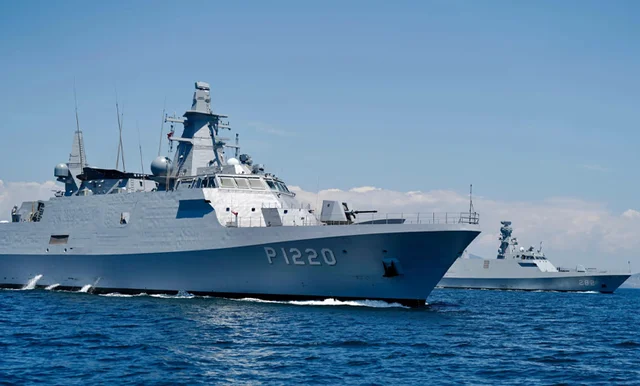
The “Open Seas” vision of the Turkish Naval Forces is gaining sustainable character not only through high-tonnage frigates, but also through flexible platforms with low operational costs whose strike capability can be increased when necessary. The HİSAR-class Offshore Patrol Vessels (OPV) carry the technological legacy of the MİLGEM project one step further, transforming the principle of “Force Economy” into a doctrinal necessity.
While these platforms maintain a sustainable presence within the Blue Homeland boundaries during peacetime, in escalation scenarios they can evolve toward a more combat-oriented profile through embedded infrastructure under the “fit-for-but-not-with” approach. This transformation does not mean that the vessel inherently evolves “fully” into a corvette/frigate role; however, it creates a flexibility space capable of enhancing deterrence in certain mission clusters.
In the later phases of the project, it is planned to transition to a standard configuration with vertical launch systems and national air defense missiles; the first ships are being constructed with “ready-in-place” infrastructure for this integration.
Strategic Summary
- Operational Design: Low-cost maritime control in peacetime and periods of tension; in wartime, combat contribution supported by network-centric capabilities.
- Force Structure Change: Replaces economically obsolete Burak-class corvettes, providing cost-effective power projection within the modernization cycle.
- Deterrence: Sustainable presence support for the protection of seismic/drilling activities within energy geopolitics and A2/AD (Anti-Access/Area Denial) constructs.
2. Mission Profile and Operational Architecture
The HİSAR class features a hybrid propulsion system in CODLOD (Combined Diesel or Electric) configuration, providing a range of 4,500 nautical miles and 21 days of endurance without resupply. This architecture delivers fuel economy and low acoustic signature at low speeds, while being able to reach a maximum speed of 24 knots when required.
This vessel is designed not merely as an “independent patrol platform,” but as a node within a force-focused network. The critical distinction here is as follows: network-centric architecture does not increase the platform’s “physical speed,” but enhances situational awareness, target information sharing, and the engagement cycle, thereby multiplying force effect.
Primary Missions
- Intelligence, Surveillance, and Reconnaissance (ISR)
- Search and Rescue (SAR)
- Counter-Terrorism and Special Operations Support
- Maritime Control and Anti-Smuggling Operations
Secondary / Combat Missions
- Naval-Air Operations (Helicopter and UAV operations)
- Protection of maritime transportation
- Asymmetric threat defense and ASW (Anti-Submarine Warfare) support
- Electronic and acoustic warfare awareness/contribution
3. Design Heritage and the “Ready-in-Place” (Fit-for-but-not-with) Philosophy
The architectural genetics of the HİSAR class are associated with the low radar cross-section and optimized hull form approach of the ADA-class corvettes. However, the platform’s primary doctrinal distinction materializes in the “ready-in-place” design philosophy.
What is “Ready-in-Place”?
“Ready-in-Place” allows the ship to operate in a simpler/economical configuration during peacetime; in crisis or wartime escalation, previously integrated infrastructure enables certain systems to be added more rapidly and with less need for heavy modification.
Core mechanisms of this transformation:
- Structural and technical infrastructure preparation: Even if weapons/sensors are not installed, space, weight margins, power infrastructure, cabling, and console layout requirements are embedded into the design from the outset.
- Rapid scalability: In crisis, pre-prepared systems can be integrated with reduced heavy modification requirements.
- Software modularity: CMS infrastructures such as ADVENT may facilitate faster system integration of newly added components (this does not compensate for kinematic speed limitations; it only accelerates integration and engagement processes).
- Economic and operational efficiency: Reduces lifecycle costs by avoiding the continuous carriage of complex and maintenance-intensive systems in peacetime.
Benefits of this Philosophy
- Light corvette approach (limited scale): Combat contribution can be expanded by increasing weapons/sensor load during crisis.
- Logistical sustainability: Personnel familiarity and parts commonality from the MİLGEM heritage reduce maintenance costs.
- Modular survivability: Upgradability throughout lifecycle according to threat perception.
4. Armament in Wartime: Current Status, Upgrade Potential, and Structural Limits
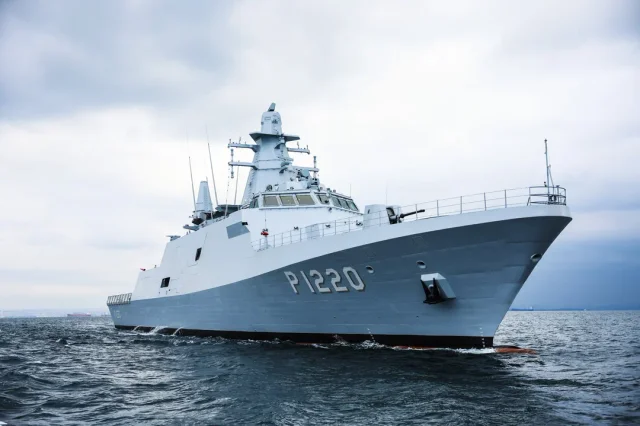
Current Configuration (Patrol Optimization)
- 76 mm main gun
- Close-in air defense system (CIWS)
- Light weapon stations
- Basic radar and electro-optical systems
This structure provides a sufficient baseline against low-intensity threats; however, it is limited in high-density naval-air missile environments.
Air Asset Capability
- Helicopter capability: Suitable for landing and takeoff of heavy-class helicopters such as the S-70B Seahawk.
- Shipborne UAV infrastructure: Control units and deployment space for 1 UAV; contributes to over-the-horizon surveillance and target detection chain.
Potential Upgrades (Doctrinal Preference Area)
- Reserve spaces: Physical space potential exists for additional weapons/systems; however, operational value requires sensor, combat management, and power infrastructure compatibility.
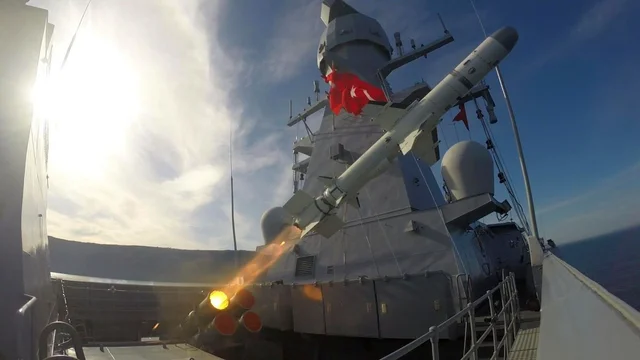
- ATMACA integration: Theoretically possible; shifts the vessel from the “OPV” line toward a “light strike” line. This is both a technical and doctrinal choice.
- Short-range air defense (VLS/RAM-like): Increases survivability.
- Modular weapon approach: Mission package concept strengthens cost-flexibility balance; however, generates second-wave costs such as stock/logistics, integration standards, and training burden.
- Electrical and power infrastructure: The real upgrade limit is often power generation/distribution and heat management capacity, not deck space. High-energy sensors or additional VLS integration require power budget analysis.
Core Question and Balanced Answer
Question: Can the HİSAR class transition from a lightly armed patrol vessel to limited combat capability in crisis escalation?
Answer: Partially yes. However, full evolution into a corvette/frigate role would confront structural limits such as speed, survivability layer, sensor/weapon density, and power infrastructure.
5. The 24-Knot Speed Issue: Gains, Disadvantages, and Operational Outcomes
The HİSAR class maximum speed of 24 knots appears low compared to modern frigates/corvettes reaching 29–30+ knots. This aligns with the vessel’s design role; however, it must be addressed objectively in terms of survivability and task group compatibility.
A) Gains: Economy, Range, Low Acoustic Signature
- Force economy: Relieves routine patrol burden from main combatants; preserves frigate hull life and operational costs.
- Economic cruise optimization: Efficient profile for range/endurance targets in the 12–15 knot band.
- CODLOD’s silence contribution: Helps manage acoustic signature at low-medium speeds; at higher speeds, propeller/flow effects increase and silence advantage may diminish.
B) Critical Disadvantages
- Survivability against high-speed threats: 24 knots narrows maneuver escape margin against kamikaze USVs and fast attack craft. This gap must be managed through early detection + strong self-defense (CIWS, etc.) + engagement discipline rather than “escaping by speed.”
- Fleet compatibility and Optempo: In 30+ knot task groups, the HİSAR class may create a speed bottleneck in some scenarios. Planning must employ the right mission/right positioning approach without forcing a “high-speed escort” role.
- Conceptual clarity: The claim of “combat contribution in crisis” encounters natural limits in ASW pursuit and torpedo evasion due to the 24-knot ceiling. The narrative must therefore reflect limited mission expansion, not full combat equivalence.
C) Mid-Level Operational Weaknesses
- Time-to-Station: The 24 vs 30 knot difference may create hours-level delay in distant theaters; significant in crisis dynamics.
- CODLOD transition/acceleration profile: Transition from electric to diesel and acceleration from 10 knots to 24 knots is a critical threat-reaction parameter.
D) Clear Distinction to Avoid Misconception
- Network-centric warfare does not make the ship faster; it only accelerates information sharing and engagement cycle.
- Role sharing via data link does not automatically grant positional superiority to a lower-speed platform.
6. Technology and Sensor Architecture: Network-Centric “Force-Focused” Contribution
The multiplier of combat effect is the ADVENT Combat Management System (CMS) and KEMENT data link architecture. This structure transforms the HİSAR class from a standalone platform into part of a force: producing “force effect” through target information sharing, joint engagement picture, and situational awareness.
Prominent Sensor Systems
- MAR-D 3D Search Radar: Selected 3D detection capability for TCG AKHİSAR and KOÇHİSAR.
- YAKAMOS 2020: Hull-mounted national sonar integrated into ASW.
- Piri-KATS and AHTAPOT-S: 360° IR/EO passive detection capability.
- YELKOVAN: Electronic warfare support for radar threat awareness.
7. ASW Capability: Not a “Hunter,” but a Sensor-Enhanced “Sentry” Role
Although designed with peacetime patrol focus, HİSAR-class OPVs can contribute to ASW missions with modern sensors. However, the conceptual distinction is clear:
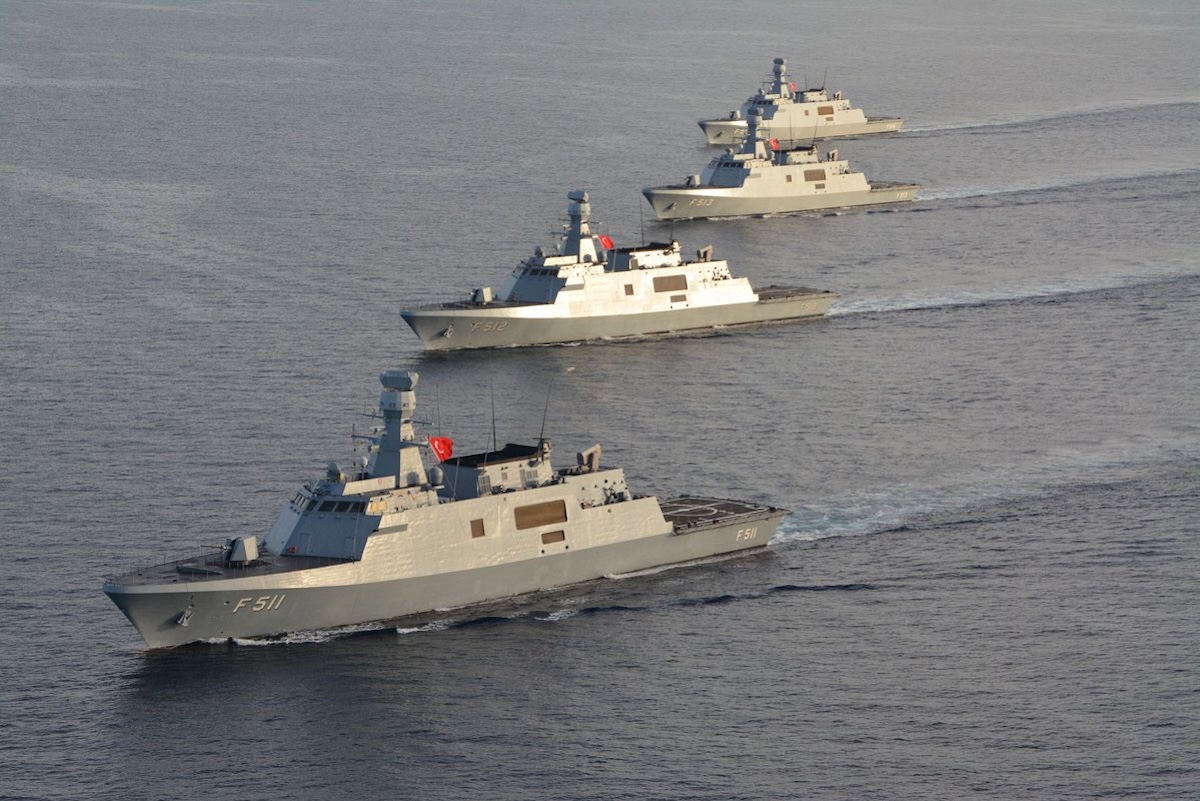
- ADA-class corvettes are closer to the ASW “hunter” role.
- The HİSAR class is positioned as a sensor-enhanced “sentry,” supporting force-level ASW and providing area awareness. As with other capabilities, ASW capacity in the HİSAR class can be increased under the ready-in-place concept.
A) Detection Capability
- YAKAMOS 2020 (hull-mounted sonar): Underwater target detection/identification.
- DÜFAS (towed sonar): Expands detection range especially against distant and quiet targets.
B) Engagement/Intervention Capability and Critical Difference
According to available configurations, the HİSAR class does not feature torpedo tubes. This is the primary distinction from the ADA class. The underwater warfare approach in the HİSAR class:
- 2 × 6-barrel ASW rocket launch systems (SDW) for engagement,
and contribution to submarine hunting via helicopter (depending on mission configuration).
8. Weapon Configuration: From Patrol Mode to Combat Contribution
The HİSAR class possesses firepower optimized for standard patrol missions. The critical technical nuance: integration of the MİDLAS Vertical Launch System (VLS) and HİSAR-D RF is planned to become standard from the third ship onward. The first two ships are constructed with “ready-in-place” infrastructure for these systems.
Weapon Components and Operational Role
- Main Gun: 76mm MKE National Naval Gun (air and surface targets)
- Air Defense: GÖKDENİZ CIWS (close defense) + HİSAR-D RF (VLS infrastructure)
- Strike Capability: 8 × ATMACA SSM (KEMENT integrated) + UMTAS launchers
- Close Defense: 12.7mm STAMP / TARGAN RCWS
- ASW Capability: 2 × 6-barrel ASW rocket launchers
9. Industrial Architecture and Program Milestones
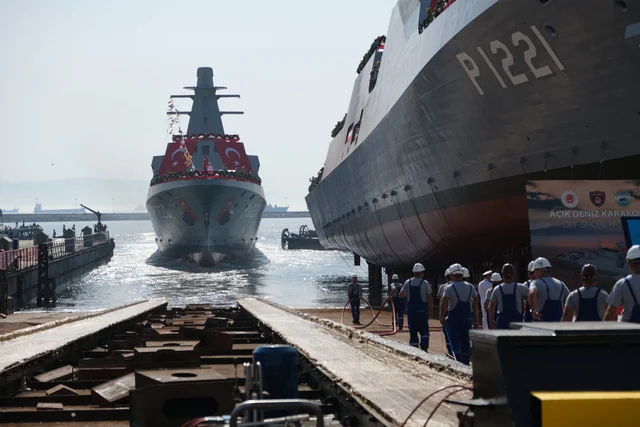
Led by ASFAT as prime contractor, the project is presented as a notable example in Turkish shipbuilding industry production tempo. Launching two ships simultaneously from the same slipway 17 months after first steel cutting demonstrates achieved production capacity.
Chronological Project Timeline
- August 2021: TCG AKHİSAR first steel cutting and construction start
- November 2022: TCG KOÇHİSAR keel laying
- September 2023: Dual launch ceremony (AKHİSAR and KOÇHİSAR)
- December 2024: TCG AKHİSAR conducts first sea trial
- 3 December 2025: Export contract signed with Romania and announcement of TCG SEFERİHİSAR (replacing AKHİSAR) with superior capabilities
- May 2026: Target commissioning of TCG KOÇHİSAR
10. Global Comparison: OPV Trends
The aim is not a “technical table race,” but to show the doctrinal evolution of OPVs within world navies.
10.1 River-class Offshore Patrol Vessel | Persistent Presence and Cost Discipline
In the British approach, OPVs are not meant to replace heavy combatants; they provide continuous flag-showing, control, and low-cost patrol. Minimalist armament supports the concept of “presence preventing war.”
10.2 Gowind-class Offshore Patrol Vessel | Modularity and Export Flexibility
In the French line, OPVs become scalable products tailored to customer sensor/weapon packages. The concept: generating different levels of power from the same platform family.
10.3 Thaon di Revel-class Patrol Vessel | Hybrid and Upgradable Platform
The Italian PPA approach establishes an “intensity scale” between OPV and frigate. Low-intensity configuration handles peacetime missions; in escalation, design logic allows approach toward heavier capabilities.
10.4 Common Outcome of OPV Evolution
The global trend transforms OPVs from “secondary platforms” into strategic instruments for gray-zone competition, energy infrastructure security, and persistent presence.
10.5 Position of the HİSAR Class
The HİSAR class positions itself along a balancing line between minimalist “pure patrol” and modular “scalable power” approaches.
11. Global Impact: Romania Export and Market Positioning
The export of the HİSAR class to Romania (approximately €223 million contract) is considered a strategic threshold as Turkey’s first sale of a combat warship to a NATO and European Union member. This sale indicates international competitiveness of the “high firepower, low-cost light corvette” concept.
Following the export of TCG AKHİSAR, the announcement that TCG SEFERİHİSAR—under construction at Istanbul Naval Shipyard for the Turkish Navy—will be equipped with superior sensor and weapon capacity reinforces the “force multiplier” effect of the platform family.
12. Critical Evaluation
Air Defense Layer
Area air defense capability is limited. In high-intensity conflict, vulnerability risk against air threats exists; this must be managed through mission concept and force planning.
High-Intensity Conflict Risk
In the modern missile environment, OPVs face heavy damage risk. Limited sensor and weapon density invalidates expectations of “destroyer/frigate equivalence.”
Debate: Corvette vs OPV Preference
The resource allocation debate begins here: More corvettes or more OPVs?
The answer depends on the balance between platform quantity and high-intensity warfare capacity.
Speed and Escort Compatibility (Speed Bottleneck Risk)
The 24-knot maximum speed may reduce operational tempo in 30+ knot task groups. Therefore, employing the HİSAR class within the “correct mission set” is critical.
It should not be forgotten that all these evaluations may differ depending on the applicability of the ready-in-place infrastructure.
13. Conclusion: The Place of the HİSAR Class in Hybrid Naval Power Architecture
The HİSAR class produces a modular response to the “Force Multiplier” requirement in modern naval warfare. Network-centric operational capability and the “ready-in-place” approach transform these ships from mere patrol platforms into flexible actors capable of providing combat contribution in certain crisis scenarios.
Nevertheless, speed limitation, task group compatibility, and survivability layer in high-intensity conflict necessitate realistic role definition: the HİSAR class is not designed to replace frigates, but to allocate frigates to the “right task” and generate sustainable presence in the Blue Homeland as an instrument of force economy.
It is appropriate to conclude the analysis with the following strategic question:
Can cost-effective and modular platforms completely replace traditional and expensive frigate-centered naval structures, or will the hybrid coexistence of these two concepts remain an unavoidable necessity for naval power projection?




